

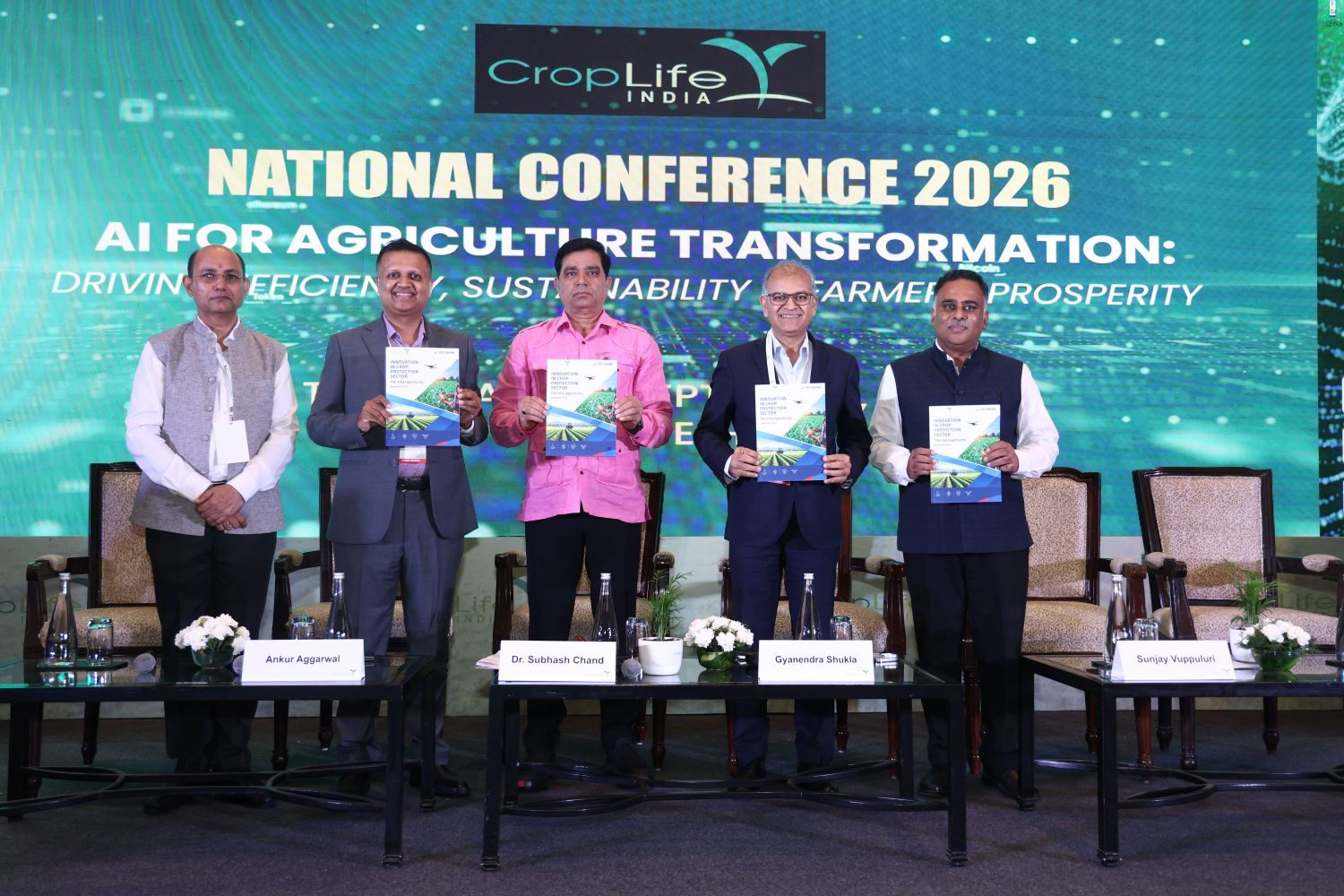

New Delhi : India can significantly address the menace of counterfeit pesticides if the National Integrated Pest Management System (IPMS) is fully implemented, said Dr. Subhash Chand, Secretary (CIB&RC), Ministry of Agriculture, while speaking at CropLife India’s National Conference on “AI for Agriculture Transformation” held in New Delhi on September 17.
Dr. Chand highlighted the role of the National IPMS database in enabling track-and-trace mechanisms and helping establish product authenticity through the authorised dealer network. He also called upon the crop protection industry to collectively develop an AI-powered tool or application that can help farmers identify pests and make informed decisions on the “right pesticide, right time and right dose.”
He emphasised that the effective use of technology and artificial intelligence can strengthen scientific, responsible and informed crop protection practices at the farm level.
CropLife India, an industry body representing 17 R&D-driven companies in the crop protection sector, organised the conference to bring together policymakers, industry leaders and technology experts to discuss the role of AI and emerging technologies in transforming Indian agriculture.
During the CEO Panel, industry leaders discussed the outlook for the crop protection sector through 2035. Ankur Aggarwal, Executive Chairman & MD, Crystal Crop Protection, highlighted the potential for innovation beyond conventional discovery approaches and noted the future role of robotics. Dr. Gyanendra Shukla, MD & CEO, Rallis India, emphasised the growing importance of digital channels and AI in shaping the industry’s next phase of growth.
Mohan Babu, COO, Bayer CropScience, said the industry is likely to move towards an integrated approach combining chemicals, biological solutions and technologies such as AI, enhanced seeds and gene editing. Giridhar Ranuva, Business Director, BASF Agricultural Solutions, highlighted the growing influence of climate change and the importance of outcome-based agriculture. Rahul Dhanuka, MD, Dhanuka Agritech, underlined the potential of India-developed AI applications to democratise mechanisation and provide solutions that could have relevance globally.
At the conference, CropLife India also unveiled a report in partnership with Yes Bank, titled “Innovation in Crop Protection Sector”. The report projects that India’s net sown area could decline by around 10% by 2050 due to conversion of agricultural land for urban uses. It also estimates that India currently loses approximately ₹2 lakh crore in crop yield annually due to pests and diseases, with climate change expected to intensify these challenges.
The report calls for greater adoption of digital technologies, stronger farmer extension services and increased domestic R&D. Among the proposed measures are incentives such as a Production-Linked Incentive (PLI) scheme, One Nation One Licence across states, and a five-year Regulatory Data Protection (RDP) incentive to encourage the development and introduction of new crop protection solutions.
Technology leaders at the conference showcased emerging AI applications across the agricultural value chain. Amit Singhee, Director, IBM Research India, discussed the company’s Prithvi foundational AI model and its use of satellite imagery for crop mapping, including applications in crop insurance and yield estimation.
Sapna Nauhria, Director (Public Sector, Asia), Microsoft, spoke about the company’s efforts to expand its ATD Baramati project to other states, where AI is being used to provide farmers with real-time pest alerts. Rucha Nanavati, Chief of Advanced Technology, Farm Equipment Business, Mahindra & Mahindra, highlighted the development of AI-powered smart advisory solutions covering different stages of the cultivation cycle.
Ashwathi Nambiar, Director AI/ML, SatSure Analytics, discussed the use of sovereign AI models backed by government initiatives and satellite data to improve forecasting of agricultural risks. Abhishek Burman, Founder & CEO, General Aeronautics, highlighted how the combination of AI, data fusion and drone-based imaging is transforming agricultural inputs and decision-making.
The conference also featured experts and representatives from organisations including Ernst & Young, Deloitte, Inera Crop Science and the Institute of Pesticide Formulation Technology, among others, reflecting the growing convergence of agriculture, technology and data-driven crop protection.