
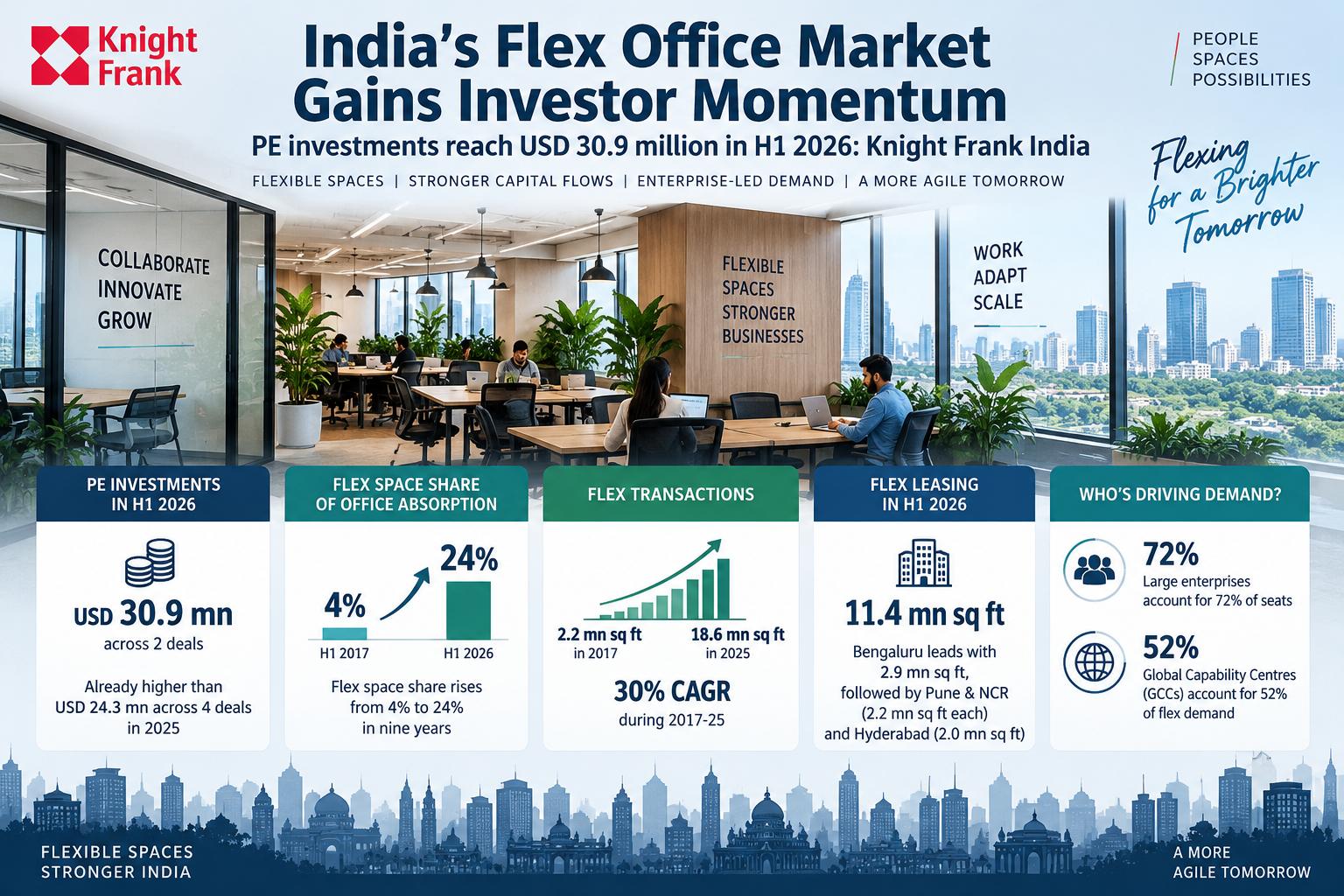

Mumbai : India’s flexible office market is entering a phase of scale, consolidation and renewed investor interest, with private equity investments in the sector reaching USD 30.9 million across two deals in H1 2026, according to Knight Frank India.
The latest investment activity in the sector comes as investors increasingly focus on enterprise exposure, operating capabilities and scalability, rather than simply the number of locations operated by flex workspace companies. Private equity investments in Indian flexible spaces have increased substantially over the past decade. Investments rose from USD 25.3 million in 2017 to USD 112.3 million in 2019, before the COVID-19 pandemic disrupted the investment cycle. The sector subsequently recorded its largest annual inflow in 2022, attracting USD 594.5 million across nine deals.
Investment activity moderated in the following years as the sector entered a consolidation phase. However, the USD 30.9 million recorded in H1 2026 has already exceeded the USD 24.3 million invested across four deals during the whole of 2025, indicating renewed investor interest and the emergence of larger-ticket transactions.
Flex Office Transactions Rise 30% CAGR
The growth in investment activity is accompanied by a significant expansion in flex office transactions. Flex transactions increased from 2.2 million sq ft in 2017 to 18.6 million sq ft in 2025, representing a 30% CAGR during the period. Flex offices have also gained a significantly larger share of India’s overall office absorption. Their share increased from 4% of total office absorption in H1 2017 to 24% in H1 2026 across the leading eight cities. The segment recorded 11.4 million sq ft of flex office leasing in H1 2026. Bengaluru led flex absorption with 2.9 million sq ft, followed by Pune and NCR with 2.2 million sq ft each, while Hyderabad recorded 2.0 million sq ft.
Enterprises and GCCs Drive Demand
The profile of flex office occupiers has also evolved significantly. Large enterprises account for 72% of seats in flex spaces, demonstrating that flexible workspaces have expanded beyond their traditional association with freelancers, startups and small businesses. Global Capability Centres (GCCs) accounted for 52% of flex office demand, highlighting the increasing role of flexible workspaces in the real estate strategies of large organisations seeking agility in capacity and location.
Viral Desai, International Partner and Senior Executive Director, Occupier Strategy Solutions, Industrial & Logistics, Capital Markets & Retail, Knight Frank India, said, “The increasing share of flex space absorption reflects a broader evolution in occupier real estate strategies in India’s commercial market. By converting fixed real estate commitments into variable capacity, it allows businesses to align space with the pace and uncertainty of growth, while creating a new intermediary layer between landlords and occupiers.”
He added that rising penetration, increasing adoption by large enterprises and GCCs, and the evolving investment profile indicate that flexibility is becoming a structural component of India’s office market rather than simply a response to changing workplace preferences. As businesses increasingly view real estate as an adaptable component of their operating strategy, the flex office segment is emerging as an avenue for workspace efficiency, market entry, expansion and faster absorption of office space.
Private Equity Investment Trend
| 2016 | 1.5 | 4 |
| 2017 | 25.3 | 6 |
| 2018 | 48.7 | 5 |
| 2019 | 112.3 | 8 |
| 2020 | 11.3 | 2 |
| 2021 | 6.2 | 2 |
| 2022 | 594.5 | 9 |
| 2023 | 59.4 | 5 |
| 2024 | 31.1 | 4 |
| 2025 | 24.3 | 4 |
| H1 2026 | 30.9 | 2 |
Source: Knight Frank Research, Venture Intelligence. PE investment amounts for certain deals are not included where information was unavailable.
The data points to the continuing evolution of India’s flex office sector, with enterprise-led demand, GCC expansion, growing leasing volumes and selective institutional capital increasingly shaping the market.