
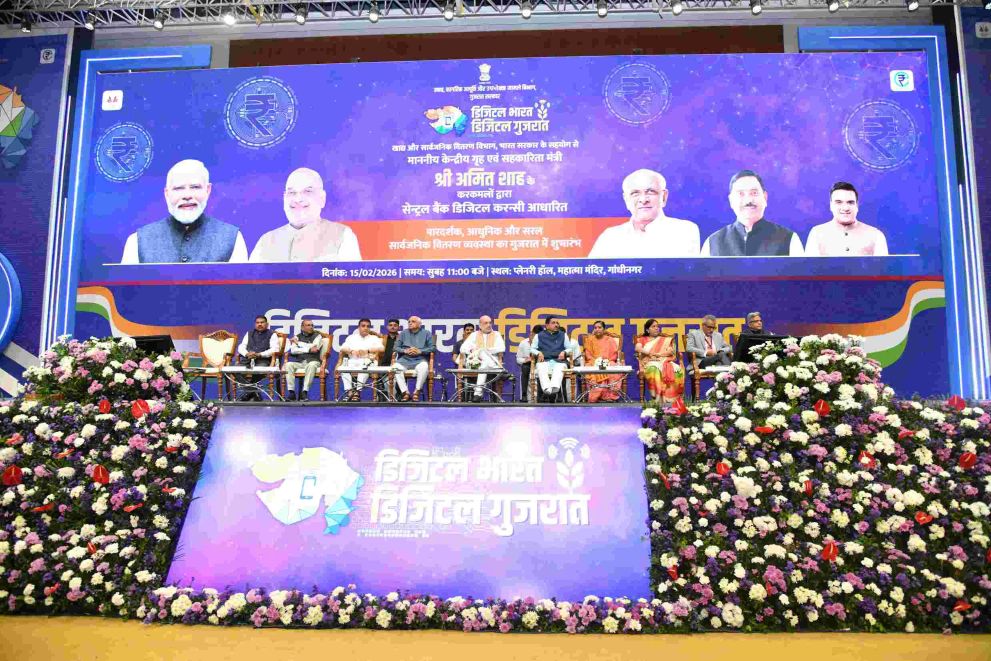

Gandhinagar : In a significant step toward building a technology-led welfare ecosystem, the Government of India today launched the country’s first Central Bank Digital Currency (CBDC)-enabled Public Distribution System (PDS) in Gandhinagar, positioning Gujarat at the forefront of digital governance and smart subsidy delivery.
The initiative was inaugurated by Union Home and Cooperation Minister Amit Shah in the presence of Gujarat Chief Minister Bhupendra Patel, Union Minister for Food and Public Distribution Pralhad Joshi, and senior officials from the Reserve Bank of India, Food and Civil Supplies Department, and partner institutions.
Digital Infrastructure Meets Welfare Delivery
The CBDC-powered model integrates India’s digital public infrastructure—Aadhaar authentication, digital currency (e₹), and real-time monitoring—to create a transparent, traceable, and leakage-proof food distribution network. The system enables beneficiaries to receive subsidized food grains through digital tokens linked to CBDC wallets, ensuring subsidies reach the intended recipient without intermediaries. Officials described the initiative as a major milestone in India’s digital economy journey, extending fintech innovation beyond banking and payments into core social welfare delivery.
‘Grain ATM’ Brings Automation and Efficiency
A key technology component of the rollout is the Annapurti Smart Grain ATM, an automated distribution system capable of dispensing 25 kg of food grains in approximately 35 seconds with precise weight and quality control. Operating 24×7, the system reduces dependency on manual processes, minimizes human intervention, and eliminates long queues at ration shops.
Beneficiaries can access food grains using QR authentication, biometric verification, or OTP-enabled access—even through basic mobile phones—enhancing financial and digital inclusion.
Strengthening Transparency and Reducing Leakages
Government officials emphasized that CBDC-based tracking ensures end-to-end visibility of subsidy flow, preventing diversion, duplicate beneficiaries, and misuse. With digital entitlements credited directly to beneficiaries’ wallets and restricted for food purchases only, the system introduces a closed-loop, purpose-driven subsidy architecture.
The initiative also aligns with the government’s broader governance framework of direct benefit transfer (DBT), financial inclusion, and digital-first public services, which have already transformed subsidy delivery across sectors.
Scalable National Model
The Gujarat rollout is being positioned as a pilot blueprint for nationwide implementation over the next three to four years. With India already accounting for one of the world’s largest digital transaction ecosystems, policymakers view the CBDC-enabled PDS as a scalable model capable of modernizing food security delivery for over 80 crore beneficiaries.
Beyond welfare, the initiative reflects India’s broader strategy of leveraging digital currency, automation, and data-driven governance to improve operational efficiency, enhance transparency, and strengthen citizen trust in public systems.
The launch marks a convergence of fintech, public policy, and digital infrastructure, signaling a new phase in India’s transition toward technology-driven, inclusive governance.