

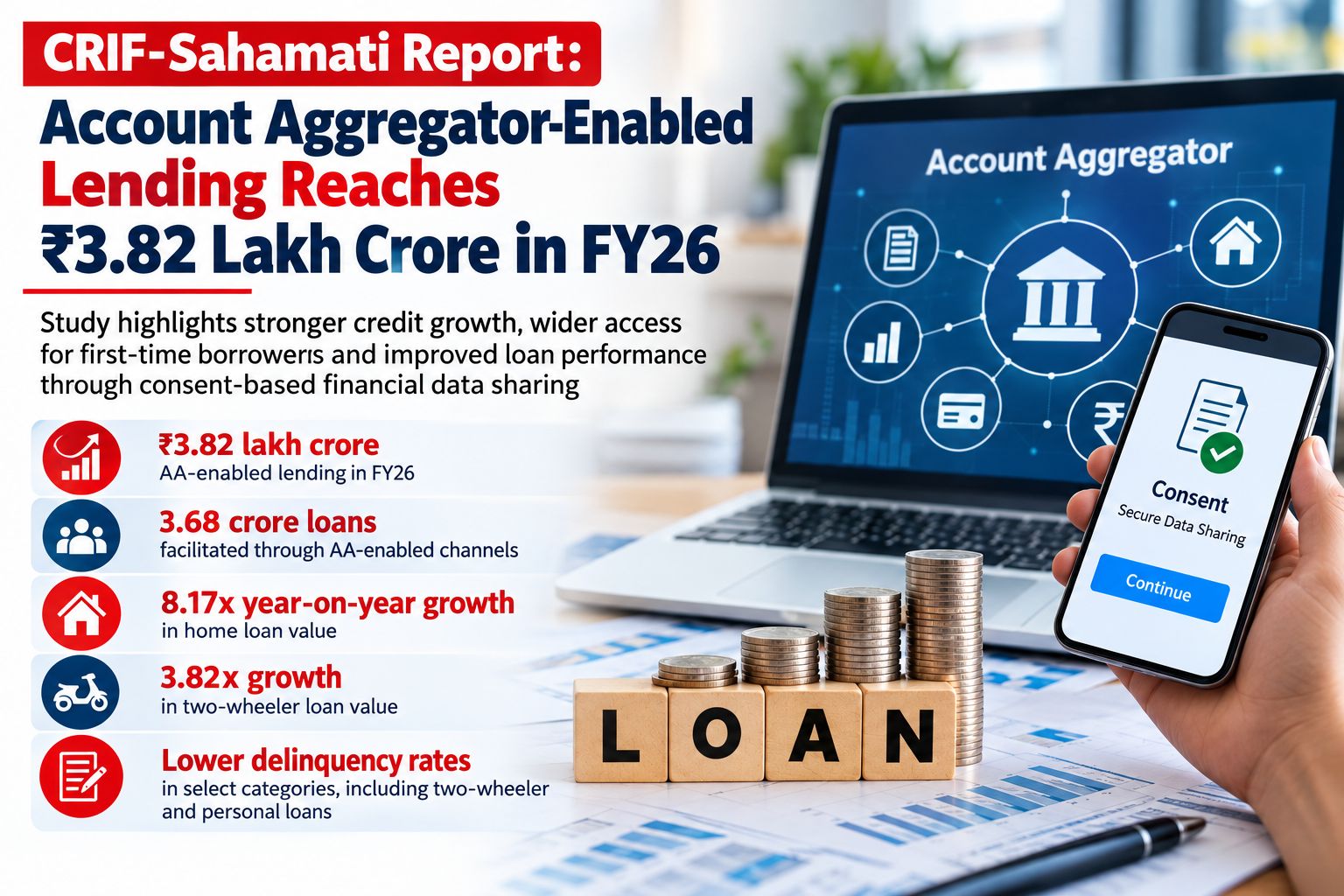

Study highlights stronger credit growth, wider access for first-time borrowers and improved loan performance through consent-based financial data sharing
Mumbai: India’s Account Aggregator (AA) ecosystem is playing an increasingly important role in expanding credit access, improving risk assessment and supporting responsible lending, according to a new report released by CRIF Credit Information Services (CRIF CIC) and Sahamati.
Titled “Consent to Credit – The Digital Way: The Account Aggregator (AA) Impact Report,” the study examines how consent-based financial data sharing is influencing credit delivery, financial inclusion and lending outcomes across India. It combines lender-level, loan-level and pincode-level analysis to assess the impact of the Account Aggregator framework.
The report estimates that AA-enabled lending reached ₹3.82 lakh crore across 3.68 crore loans in FY26, highlighting the rapid expansion of consent-driven lending in the country.
According to the study, lenders leveraging the AA ecosystem are recording stronger portfolio growth, greater penetration among new-to-credit borrowers and improved underwriting outcomes. They are also expanding their reach into underserved markets, including Tier 3 and smaller locations.
Account Aggregator Ecosystem Expands Rapidly
Since becoming operational in September 2021, the Account Aggregator ecosystem has grown significantly. As of August 2026, it comprised 16 operational Account Aggregators, 176 Financial Information Providers and 1,144 Financial Information Users. The ecosystem had facilitated more than 566 million fulfilled consents and linked over 338 million accounts, according to the report.
Lending has emerged as the dominant use case, with financial institutions increasingly using consent-based access to financial information to support credit assessment and lending decisions.
Key Findings Highlight Credit Growth and Inclusion
The report highlights several trends across retail and business lending segments. Housing and property loans: AA-enabled lender cohorts recorded more than twice the two-year portfolio growth of non-AA lenders, indicating stronger expansion in housing and property-related credit. Greater access for first-time borrowers: AA-enabled lenders recorded a higher share of new-to-credit borrowers in mid-ticket business loans, at 28.5% compared with 8.6% for non-AA cohorts. In personal loans, the corresponding shares stood at 9% and 3.8%, respectively.
Growth in home and two-wheeler loans: The value of home loans sanctioned through AA-enabled channels grew 8.17 times year-on-year, while the value of two-wheeler loans increased 3.82 times. Loan performance: AA-enabled loans recorded lower 90-day-plus delinquency rates in select categories. The rate stood at 0.5% for two-wheeler loans, compared with 5.3% for non-AA loans. For personal loans, the respective rates were 2.0% and 2.2%.
Broader financial inclusion: Greater exposure to the AA ecosystem was associated with increased lending to new-to-credit borrowers, customers in Tier 3 and beyond markets, and women, particularly in retail credit.
Potential to Strengthen Business Lending
While the report identifies progress across several retail lending categories, it also points to opportunities to expand the use of Account Aggregators in business lending.
The integration of Goods and Services Tax (GST) records into the AA ecosystem could help address existing information gaps and support wider access to formal credit for businesses. The report’s pincode-level analysis also examined the relationship between AA exposure, local economic activity and lending growth. Its findings indicate a positive association between AA exposure and retail credit, particularly in housing, personal and auto loans.
Industry Leaders Highlight the Role of Consent-Based Data
Sachin Seth, Regional Managing Director, India and South Asia, CRIF, said the Account Aggregator framework was helping bridge information gaps that have historically restricted access to formal credit, especially for new-to-credit borrowers, small businesses and underserved segments.
He noted that trusted, real-time financial data could support better risk assessment, faster decision-making and more inclusive credit growth as the ecosystem matures. Shalini Gupta, Chief Policy and Advocacy Officer, Sahamati, said the next phase of credit growth would depend on how effectively lenders use reliable financial information to assess borrowers beyond traditional credit histories.
She highlighted the role of consent-based access to verified financial data in helping lenders make informed decisions while allowing individuals to retain control over their financial information. She also emphasised the need to expand adoption, integrate additional data sources and extend the benefits to underserved borrowers and small businesses.
Account Aggregator’s Growing Role in Digital Finance
The findings underline the growing role of the Account Aggregator framework in India’s digital financial infrastructure. By enabling consent-based access to financial information, the ecosystem can help lenders improve underwriting, calibrate risk more effectively and reach borrowers who may have limited traditional credit histories. As adoption expands and additional data sources become available, the framework could further support responsible lending, financial inclusion and broader economic growth.