

Five-Day Programme Focuses on Emerging Financial Crime Risks, FATF Methodologies and BRICS Best Practices
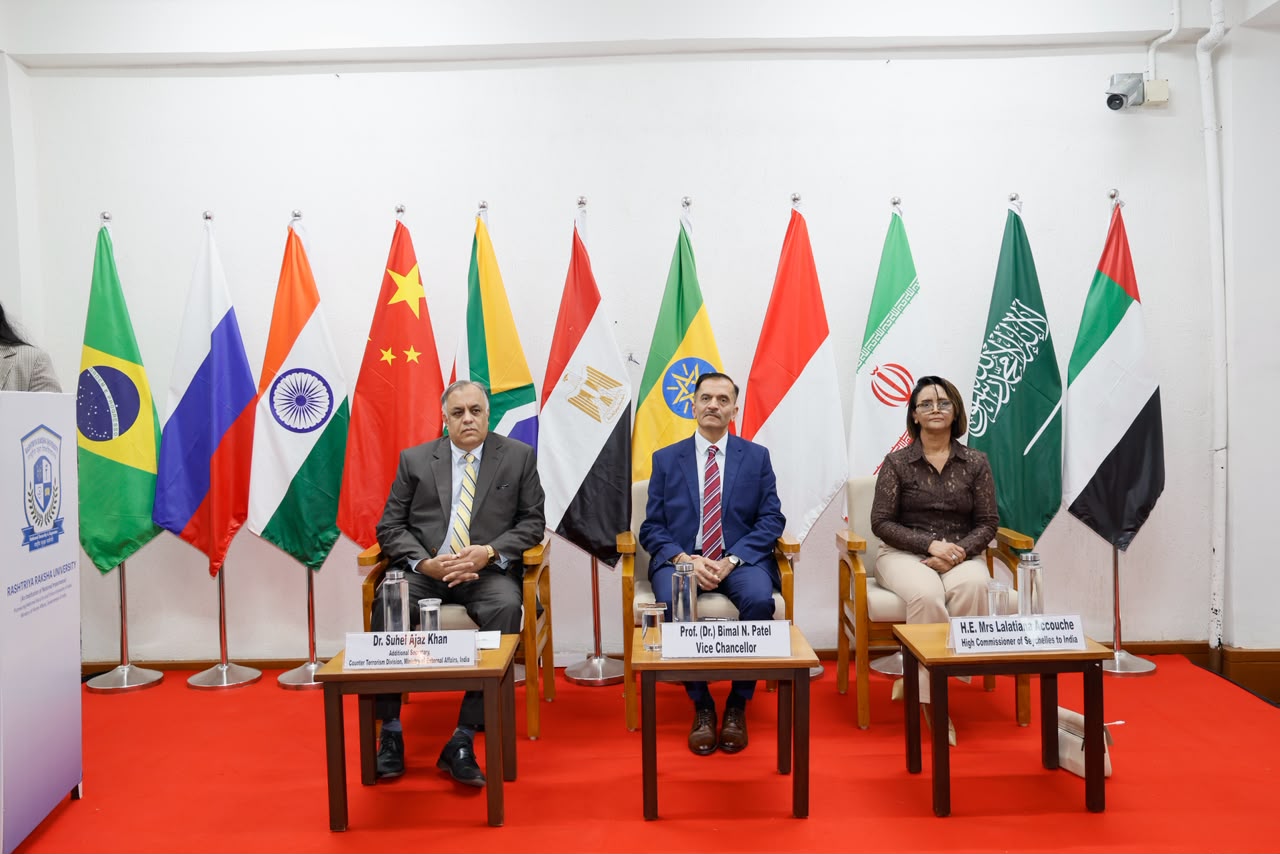
Gandhinagar, September 11, 2026: Rashtriya Raksha University (RRU), an Institution of National Importance, successfully concluded a five-day BRICS Anti-Money Laundering (AML) and Countering the Financing of Terrorism (CFT) Capacity Building Programme at its Lavad campus in Gandhinagar. The international capacity-building programme focused on emerging financial crime risks, Financial Action Task Force (FATF) methodologies and BRICS best practices, bringing together delegates and experts to strengthen cross-border financial security, institutional capacity and compliance frameworks. The valedictory ceremony was attended by Prof. Dr. Bimal N. Patel, Vice-Chancellor, RRU; Dr. Suhel Ajaz Khan, Additional Secretary, Counter-Terrorism Division, Ministry of External Affairs (MEA), Government of India; and Her Excellency Mrs. Lalatiana Accouche, High Commissioner of the Republic of Seychelles to India, who addressed the gathering as Guest of Honour and Chief Guest, respectively.
RRU’s Global Security Education Vision
Delivering the Welcome Address, Prof. Dr. Bimal N. Patel highlighted RRU’s commitment to extending security education, research and innovation across the Global South. He emphasised RRU’s integrated academic approach that brings defence and police forces together on a common platform and underlined the importance of collective security among nations. Prof. Patel also invited participating countries to collaborate with India and RRU in establishing similar security laboratories and centres of excellence in their respective jurisdictions.
Strengthening Global Response to Terror Financing
In his Special Address, Dr. Suhel Ajaz Khan highlighted the continuing global threat posed by terrorism and its dependence on illicit financial networks. He stressed the need for international systems to continuously adapt to emerging challenges involving digital platforms, virtual assets and complex corporate structures. Dr. Khan highlighted the FATF’s 11 Immediate Outcomes, covering areas including financial intelligence, beneficial ownership and targeted financial sanctions, as important benchmarks for strengthening global preparedness against money laundering and terrorist financing. He also highlighted India’s robust AML/CFT framework and its high level of technical compliance recognised in the 2024 FATF Mutual Evaluation, while emphasising the importance of multilateral cooperation through the BRICS framework.
India-Seychelles Partnership
Addressing the delegates, Her Excellency Mrs. Lalatiana Accouche highlighted the longstanding partnership between India and Seychelles, particularly as the two countries mark the 50th anniversary of their diplomatic relations. She noted that increasingly sophisticated and transnational criminal networks require law enforcement agencies to continually strengthen investigative and analytical capabilities. Highlighting the shared maritime security interests of India and Seychelles in the Indian Ocean region, she described international capacity-building programmes as an important means of empowering professionals, strengthening institutions and developing sustainable cross-border networks.
India’s BRICS Capacity-Building Initiative
During one of the programme sessions, Mr. Smarak Swain, Director, FATF Cell, Ministry of Finance, highlighted India’s initiatives under its BRICS chairmanship to strengthen international cooperation on AML/CFT. He noted that the BRICS leadership had resolved through the Kazan Declaration of 2024 and the Rio de Janeiro Declaration of 2025 to enhance dialogue on anti-money laundering and countering the financing of terrorism. As part of India’s BRICS chairmanship, four capacity-building programmes were hosted during the year. These included a FATF Cell webinar, a programme conducted in partnership with the National Academy of Direct Taxes (NADT) in Nagpur, training by RBI Staff College in Chennai, and the concluding programme hosted by RRU at its Gandhinagar campus.
Focus on Emerging Financial Crime Risks
The concluding programme provided participants with practical exposure to emerging risks in financial crime and the application of FATF methodologies. Participants engaged with frameworks and approaches related to cross-border evidence sharing, risk coordination and disruption of terrorist-financing networks, strengthening their ability to respond to increasingly complex and transnational financial threats.
RRU’s Expanding International Footprint
Over the past five years, RRU has evolved into a strategic institution for security education and international capacity building, with more than 60,000 beneficiaries. Through partnerships with the Ministry of External Affairs and other international collaborations, the University has trained more than 3,000 participants from over 90 countries, strengthening its position in the fields of internal security, policing and defence management. The programme concluded on September 11, 2026, ahead of the upcoming BRICS Summit in New Delhi, with continued international cooperation on counter-terrorism and financial security expected to remain an important area of multilateral engagement.