
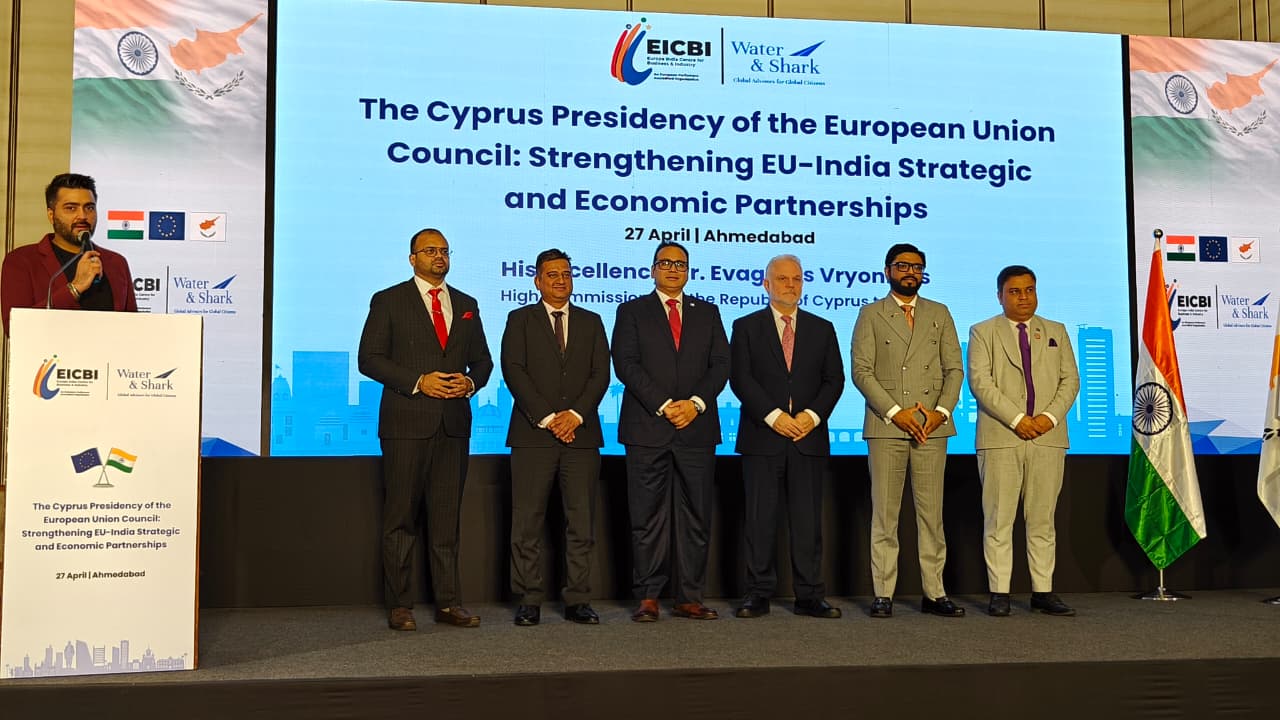

Ahmedabad : A high-level strategic dialogue hosted by Water & Shark in collaboration with the Europe India Centre for Business and Industry brought renewed focus to the evolving India–Europe economic relationship, positioning Cyprus as a key enabler within the broader EU engagement framework.
Held at DoubleTree by Hilton Ahmedabad, the dialogue centred on the theme “The Cyprus Presidency of the Council of the European Union: Strengthening EU-India Strategic and Economic Partnerships.” The event convened diplomats, policy experts, and business leaders to examine how trade, regulation, investment flows, technology collaboration, and geopolitical shifts are reshaping India’s engagement with Europe.
The discussions underscored a significant transition in India–EU relations—from traditional trade interactions to a more integrated framework driven by regulatory alignment, sustainability mandates, supply chain diversification, and strategic economic cooperation. Within this context, the Cyprus Presidency of the Council of the European Union was highlighted as a timely opportunity to strengthen institutional and business linkages.
Cyprus’s geographic positioning and institutional role within the European Union were identified as strategic advantages, offering India a gateway into European markets and Mediterranean economic networks. Participants emphasised that engagement with such strategically placed EU member states can enhance India’s access to policy dialogue, trade facilitation, and investment ecosystems.
Harsh Patel, CEO of Water & Shark, noted that Europe is rapidly becoming central to India’s external economic strategy. He emphasised that businesses must move beyond viewing international expansion purely as a market opportunity and instead approach it as a structural decision involving compliance frameworks, taxation, governance, and long-term positioning.
The dialogue also reflected the growing importance of advisory-led international expansion. As Indian enterprises increasingly look towards Europe, success will depend on their ability to navigate complex regulatory environments, align with evolving policy standards, and integrate strategic planning with execution.
The involvement of EICBI added institutional depth to the platform, reinforcing the role of collaborative engagement between business and policy ecosystems. The discussion was framed within the broader context of Track 1.5 diplomacy—where industry bodies and strategic forums complement formal diplomatic channels.
Sujit Nair, Senior Partner at Water & Shark and Chairman of EICBI, highlighted that the India–Europe corridor represents more than commercial exchange. He described it as a reflection of deeper strategic alignment built on institutional trust, policy coherence, and the ability to translate diplomatic intent into tangible economic outcomes.
The event also underscored Gujarat’s growing role in India’s global economic engagement. With its strong industrial base and outward-looking business ecosystem, the state is well positioned to participate in Europe’s regulatory-driven markets, provided enterprises are equipped to meet compliance and governance standards.
The Ahmedabad dialogue ultimately reflected a broader shift in global economic engagement—where diplomacy, trade, and business strategy are increasingly interconnected. By focusing on Cyprus within the India–EU corridor, the platform demonstrated how regional initiatives can contribute meaningfully to national economic ambitions, enabling businesses to align with emerging global opportunities and policy directions.